

The widest catalog does not always lead to the best choice. When looking for a designer furniture store in the Dominican Republic, the difference lies in recognizing whether each piece responds to a need or just takes up space on a list. Online, that distinction requires looking beyond the photograph: review the selection, the information for each product, and the relationship of the furniture with the dimensions and style of your home at ASR Design.
It is natural to want to check materials, proportions, and finishes before deciding. When evaluating an online store, a clear product sheet and a careful reading of the whole help to resolve doubts. Even so, measure the space and check the materials indicated for each piece before choosing.
In this article, you will see how to evaluate a store by the coherence of its catalog, the information it offers, and the way in which its pieces can be integrated into the space. You will also find criteria to guide your search according to the function of each environment and relate furniture, accessories, and art. Thus, each choice can stem from a concrete need and contribute to a balanced environment.
Key Points
- A specialized store is distinguished by the coherence of its selection, not just by the number of pieces it presents.
- Before choosing, define what the space needs and review measurements, function, materials, and visual relationship with the surroundings.
- When buying online, consult the current product sheet and separate the published information from the details that should be confirmed directly.
- Use the function of each environment to explore furniture categories, without assuming that the same solution serves all spaces.
- Consider how furniture and works of art can form a joint composition while still addressing the practical needs of the home.
Designer furniture store: what does a specialized selection offer?
A designer furniture store gathers pieces chosen for the relationship between form, function, and materials. Thus, each piece of furniture can be valued as much for its presence as for the use it will have in daily life.
This definition distinguishes it from a directory. A directory gathers businesses and contact information; a specialized store presents products that can be compared by category and by the information available on each piece. When exploring a selection, look at what is offered and what attributes can be verified, not just how many images or names appear.
What distinguishes a designer furniture selection
Observe the proportion of the piece in relation to the space, its silhouette, and the function for which it was conceived. A dining chair must respond to that use; an armchair can invite rest or be part of a gathering area. The image may attract, but daily utility determines if the piece makes sense in the home.
Signature design is also not demonstrated by adjectives like "exclusive" or "high quality." Look for verifiable data, such as the manufacturer or designer, the materials, and the measurements, if they are published in the product sheet. The history of furniture offers a broad context on how its materials and functions are also part of its decorative expression. To evaluate a specific piece, the main reference should be its current information.
What categories to look for according to the home's needs
Start with the activity you want to facilitate. This guide relates common needs to furniture categories:
- Rest and gathering: sofas, armchairs, benches, and ottomans can respond to different ways of gathering or relaxing.
- Dining room: tables and chairs fulfill complementary functions; value the available space and the circulation around them.
- Bedroom: beds and nightstands address different needs within the environment.
- Support and light: side tables, consoles, and lamps complete the composition without replacing the main pieces.
The category guides the search, but does not decide for you. A photograph can inspire a composition, but it does not confirm that the dimensions, function, or proportion are adequate for your home. Start by defining the use of the environment and then compare the pieces carefully.
How to evaluate designer furniture before choosing a piece
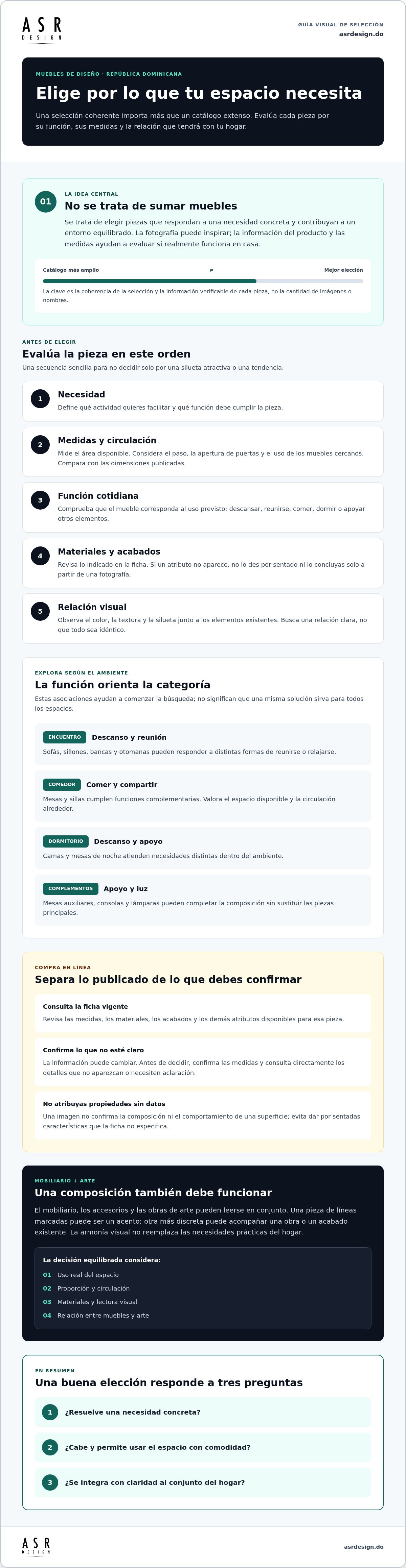
An image can show the character of a piece of furniture, but it does not confirm if it will work in your home. To evaluate a piece online with criteria, follow a simple order: need, dimensions, function, materials, and visual relationship with the environment. Thus, the decision will not depend only on an attractive silhouette or a passing trend.
An adequate piece responds to a concrete need, fits proportionally into the space, allows for circulation, and harmonizes with the materials and forms already present. These criteria coincide with principles for selecting furniture, which prioritize practicality, style, and harmony.
Measurements, function, and space circulation
Before comparing options, measure the available area and consider the space for walking, opening doors, and using nearby furniture. Then, contrast those measurements with the dimensions published in the current product sheet. Since information can change, confirm the measurements before deciding.
Compare the piece with the furniture that will remain in the environment. A sofa, for example, must maintain a reasonable proportion with nearby tables and chairs, in addition to allowing for comfortable circulation. First, define how you will use the space; then, value the form.
Materials, finishes, and visual reading
Look in each product sheet for the indicated materials and finishes, in addition to the dimensions and other available attributes. If a piece of data does not appear, do not take it for granted: the photograph does not allow for confirming the composition or the behavior of a surface. Also, do not attribute resistance or durability to a piece without specific product information.
To value harmony, observe the color, texture, and silhouette together with the elements you already have. A piece with marked lines can become an accent; a more discreet one can accompany a work of art or an existing finish. The goal is not for everything to match identically, but for each element to have a clear visual relationship with the others.
This methodology also works when evaluating a designer furniture store in Santo Domingo: photographs provide guidance on appearance, while the product sheet provides data to contrast with real needs. You can apply these criteria when exploring the home furniture catalog and verify the current information for each piece before moving forward.
Buying designer furniture online: how to reduce uncertainty
Buying online allows you to explore different pieces calmly, but a photograph alone does not offer all the necessary information. To decide with more clarity, follow this sequence: review the product sheet, identify what data is missing, resolve doubts, and then add the furniture to the cart. A designer furniture store in Santo Domingo may present an attractive catalog; the purchasing decision, however, must be based on verifiable attributes and current conditions.
What to check in the furniture product sheet
Start by confirming the category of the piece and reading the full description. Review the published dimensions, materials, and finishes. If there are images from different angles, use them to appreciate the silhouette, proportions, and visible details. A photograph can suggest texture or color, but it does not confirm by itself the composition of the material or other attributes that are not specified.
Before continuing, write down pending questions. If a measurement is not indicated or a finish is not described clearly, do not infer it from the image. Consult directly with the store and contrast the answer with the current product sheet. This way, you will be able to distinguish what is published from what requires confirmation.
From cart to payment: confirmations before finalizing
Once the piece is selected, review the order summary and the data requested during the process. Before paying, confirm the conditions that may influence the decision, especially the coverage and the policies for delivery, changes, and returns. Do not assume that these terms are the same in all stores: consult current information before completing the purchase.
PayPal is listed as a visible payment method in the information available from ASR Design. Verify that it still appears as an option in the current process and review the conditions shown before confirming. Do not assume that other methods, protections, or payment options exist if they are not expressly indicated.
- Product sheet: confirm the category, measurements, materials, and published finishes.
- Doubts: identify which details cannot be established from the images or the description.
- Order: review the summary and the conditions for delivery, changes, and returns before paying.
With these clear criteria, you can go through the home furniture catalog and stop at the pieces that respond to a concrete need. Carefully reviewing the information allows for buying with more clarity, without confusing visual inspiration with confirmed data.
How to relate furniture to each home environment
A balanced composition begins with the use of the environment and the available dimensions. Images can inspire, but they do not offer a universal recommendation: a piece that works in a large living room may not have the same presence or utility in a compact space. Measure the area and existing furniture before deciding how to organize it.
The main piece establishes the scale and character. Supportive furniture and accessories complete the scene without competing with it. You can also consider how materials and forms dialogue with a nearby work of art. The intention is to create visual relationships, not to fill every surface.
Main and complementary pieces in the living room
In the living room, a sofa or armchair can serve as a reference for distributing the other pieces. Value its proportion with respect to the area and leave room to circulate. A coffee or side table can accompany the planned activity, provided its size and location are functional. It is not necessary to incorporate both if the environment does not require it.
A lamp and some accessories provide layers of light, texture, or color. To maintain a serene reading, choose complements that accompany the main piece and leave visual space around them. If a work of art occupies a prominent place, the furniture can frame it without taking away its prominence.
Dining room and bedroom: function before accumulation
In the dining room, relate the table and chairs to daily use. Consider how many seats you usually need and how much space remains to move around the set. The image of a composition can serve as a reference, but the measurements of the environment determine if that arrangement is viable.
In the bedroom, the bed responds to the central function; nightstands and other auxiliary furniture must cover concrete needs, such as offering a support surface, without obstructing the path. Maintain enough visual space so that each piece retains its presence.
| Environment | Need | Relevant categories |
|---|---|---|
| Living room | Rest and gathering | Sofas, armchairs, coffee or side tables |
| Dining room | Sharing meals | Dining tables and chairs |
| Bedroom | Rest and daily support | Beds and nightstands |
Explore the furniture and accessories catalog as a starting point. Compare categories with the needs of the environment and review the measurements of each piece before choosing.
ASR Design: furniture and art in the same curatorial view
ASR Design is an online store for home furniture and accessories. Its proposal relates the pieces in the catalog with works from ASR Contemporáneo, a connection that invites one to think of the environment as a whole and not as a sum of isolated objects. For those looking for a designer furniture store in Santo Domingo, this view offers a starting point to explore both the function of the furniture and its visual dialogue with art.
A selection that incorporates furniture, accessories, and art
The catalog gathers categories such as sofas, chairs, tables, beds, and lamps. Each can guide the search according to the intended use: rest, gathering, dining, or sleeping. The works of ASR Contemporáneo broaden that reading: art can establish a visual accent, while furniture provides scale and function. The relationship between both will depend on the pieces and the characteristics of each space.
The offer also includes pieces from other manufacturers, such as FEELINGS. That reference identifies a manufacturer present in the catalog, not an in-house collection. When comparing options, base the decision on the information published for each product and do not infer materials, finishes, or characteristics that are not specified.
A simple route to explore the catalog
Start with the environment you wish to address and the activity that occurs there. For a rest area, review the sofa or armchair categories; for a dining room, consider tables and chairs. Then, observe how the silhouette, color, and scale of the piece could relate to the elements that are already part of the space, including works of art.
Before deciding, consult the current product sheet for each piece of furniture. Verify the measurements, finishes, and indicated availability, in addition to the corresponding purchase conditions. If a necessary piece of data does not appear, confirm it directly with the store. The image can inspire a composition, but real dimensions and product information help to determine if that idea fits the home.
The tour can be leisurely. Compare categories by function and observe how furniture and art could coexist without competing for attention. To get to know the online selection, Explore the ASR Design selection.
Choose pieces that give meaning to the space
Choosing with intention begins by defining what each environment needs. Then, the measurements, function, and verifiable information for each piece help to decide if its presence will be as adequate as its appearance. The photograph inspires, but the dimensions and details of the product sheet allow you to contrast that impression with the real conditions of the home.
When looking for a designer furniture store in Santo Domingo, also value the coherence of its selection. ASR Design brings together furniture and accessories for indoors and outdoors, and links its pieces with works by ASR Contemporáneo. That relationship allows one to consider furniture and art as parts of the same composition, without losing sight of daily use.
Go through the catalog according to the function you wish to address and review the current information before choosing. Explore the ASR Design furniture and accessories selection.
A well-thought-out choice does not need to be imposing. It is enough that it responds to the space and naturally accompanies the life that happens in it.
Frequently asked questions
What characterizes a designer furniture store?
A designer furniture store presents pieces selected for the relationship between form, function, and materials. Its catalog allows you to explore furniture according to its use and review the information available for each product. To distinguish a specialized selection from a directory, look at whether you can compare categories, features, and product sheets, instead of only finding contact details for different businesses.
How can I choose designer furniture for my home?
Start by identifying what you need to solve in the environment. Then compare the furniture's dimensions with the available space, consider its daily function, and review the indicated materials and finishes. Finally, observe how its silhouette and color relate to existing elements. An image can inspire, but the choice must respond to the real measurements and activities of the home.
What should I check before buying furniture online?
Revisen la categoría, las medidas, los materiales, los acabados y las imágenes de la ficha vigente. Distingan los atributos descritos de aquellos que no se pueden confirmar en una fotografía. Antes de agregar la pieza al carrito, anoten sus dudas y consúltenlas con la tienda. También verifiquen las condiciones de entrega, cambios y devoluciones antes de completar el pago.
¿Puedo combinar muebles de diseño con arte contemporáneo?
Sí. El mobiliario puede aportar función y escala, mientras que una obra de arte establece un acento visual. Para mantener una relación equilibrada, consideren la ubicación, los colores, las texturas y la presencia de cada elemento. ASR Design vincula su catálogo de mobiliario con obras de ASR Contemporáneo, lo que permite explorar ambas expresiones como componentes de un mismo ambiente, sin asumir que existe una combinación universal.
¿Cómo sé si un mueble cabe en el espacio disponible?
Midan el área donde planean ubicarlo y comparen ese espacio con las dimensiones publicadas en la ficha vigente. Consideren también la circulación y la relación con los muebles cercanos. Si la pieza debe pasar por puertas o pasillos, midan esos accesos antes de decidir. No se guíen únicamente por la fotografía, ya que la perspectiva puede alterar la percepción de escala.
¿Qué categorías de muebles ofrece ASR Design?
ASR Design ofrece sofás y seccionales, sillones, bancas, otomanas, divanes, sillas de comedor, bancos para barra, mesas de comedor y auxiliares, mesas de noche, consolas, escritorios, camas, sillones para exteriores y lámparas. El catálogo también incluye accesorios para el hogar. Revisen las fichas vigentes para confirmar las características y disponibilidad de cada pieza antes de elegirla.
¿Qué métodos de pago aparecen en la tienda en línea de ASR Design?
PayPal figura como método de pago visible en la información disponible. Como las opciones pueden cambiar, confirmen cuáles aparecen en la tienda al momento de comprar y revisen el resumen del pedido antes de finalizar. No den por disponibles otros métodos ni condiciones particulares de pago si no están indicados en el proceso vigente.
